The correct way to apply a serum starts with its instructions. “Serum” describes a product format, not one standard formula. Different products can require different amounts, application areas, skin conditions and timing.
If a serum pills, stings or seems unhelpful, technique is only one possibility. The formula may not suit you, the expected benefit may be unrealistic or the problem may need assessment. This guide walks through a practical application check without promising that a fixed number of drops or a timer will make every product work.
At a Glance
- Use the amount on the label — there is no universal drop count or pump conversion.
- Check damp- or dry-skin instructions — do not change a medicine’s directions to increase absorption.
- Apply gently with clean hands — a special tool or warming ritual is not required by this guide.
- Follow any stated waiting time — a one-minute pause is not a universal compatibility rule.
- Keep serum optional — it does not replace moisturizer, sunscreen or prescribed treatment.
Start here → Routine Order & Layering Hub — where products fit and how to troubleshoot layers.
Before the Next Application
Read the outer packaging and leaflet as well as the bottle. If instructions are unclear, ask the manufacturer or pharmacist before guessing. For a prescribed product, use the prescriber’s directions and clarify any apparent conflict.
Check:
- The exact product and intended purpose.
- Whether it is a cosmetic or a medicine.
- The amount, frequency and permitted application areas.
- Whether skin should be dry or damp.
- Any waiting, rinsing, sun-exposure or storage instructions.
- Warnings about other products, pregnancy, age or irritated skin.
- Whether the product has changed in smell, color or texture.
Do not assume that another bottle with the same highlighted ingredient has the same instructions. A vitamin C solution, a retinol cosmetic and a prescription treatment cannot all be treated as identical serums.
Five Steps for a Product-Specific Application
Step 1: Prepare Skin as Directed
Wash your hands. Cleanse gently when the product’s directions call for clean skin, and avoid scrubbing. Pat dry rather than repeatedly rubbing with a towel.
There is no need to estimate that your face is a particular percentage dry. Some cosmetic hydrating products are intended for damp skin; others have different directions. A medicine may require fully dry skin or a stated wait after washing. Follow that instruction rather than using dampness to try to drive the product deeper.
Toner is optional. You do not need to buy it to prepare the skin for serum or to correct a cleanser that leaves your face sore. If your skin is already irritated, review whether to use the optional product at all instead of changing the water content underneath it.
Step 2: Measure the Product’s Amount
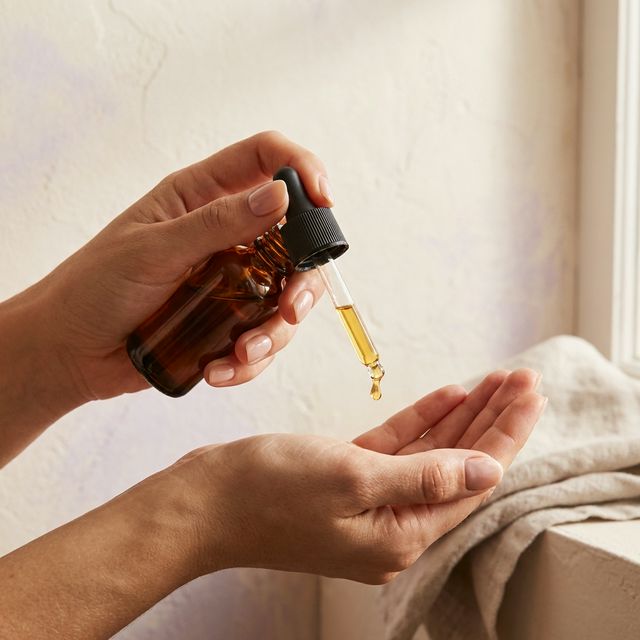
There is no universal drop count for a whole face. Droppers, pumps, textures and treatment areas differ. Use the stated amount or ask for clarification if the directions are vague, especially for a medicine.
| Packaging or Instruction | What to Do | What Not to Assume |
|---|---|---|
| A stated number of drops | Use that product’s directions | Every dropper releases the same volume |
| A stated number of pumps | Follow the specific dispenser instructions | Half a pump equals a fixed number of drops |
| A measured amount for a medicine | Follow its label and prescription | A cosmetic serum rule overrides the dose |
| An unclear amount | Ask the manufacturer or pharmacist | A full dropper or a tiny drop must be correct |
Do not apply extra to make results arrive sooner. Also, do not reduce a medicine’s dose on your own because an online guide says a few drops are enough. How long a bottle lasts depends on its volume, instructions and area of use; running out by a particular week does not by itself prove overuse.
Step 3: Distribute Gently and Keep the Container Clean
Apply by the method the product specifies. Clean fingertips are suitable for many products. Avoid unnecessary rubbing, pressure or dragging around delicate areas. Pressing or patting is not proof of deeper delivery, and deliberately warming a serum is not required here.
Keep the opening or dispenser clean and close the container after use. Avoid transferring used product back into the bottle. Do not dilute a serum or medicine with water to make it spread farther. Follow the manufacturer’s storage advice rather than assuming every serum belongs in a refrigerator.
Use a product near the eyes only if its directions allow that area, and keep it out of the eyes. A face serum is not automatically suitable for the eyelids, lash line, neck or broken skin. Check each intended area rather than extending the application because there is some product left on your hands.
Step 4: Follow Timing Instead of an Absorption Test
If the label or prescriber specifies a wait, follow it. There is no single sixty-second or two-minute interval that makes every serum effective. A tacky finish does not measure how much ingredient entered your skin, and a smooth finish does not prove treatment benefit.
Do not mix separate products in your palm unless their instructions specifically permit it. If layers remain awkward, review the amount and directions and consider leaving out an optional cosmetic. For medicine combinations or conflicting directions, ask a pharmacist.
If you need to let a layer settle before makeup for cosmetic reasons, keep that separate from a claim that a particular wait guarantees absorption. Your routine can be practical without turning every interval into a clinical rule.
Step 5: Complete the Rest of the Routine
A general order from the AAD is gentle cleansing, treatment, moisturizer and/or sunscreen, then makeup. Product-specific instructions take priority. A thin-to-thick rule cannot establish where every medicine belongs, and a serum is not necessarily ineffective if its own directions place it after another product.
Use a comfortable moisturizer as appropriate. Include broad-spectrum, water-resistant sunscreen with SPF 30 or higher in daytime sun protection, alongside shade and protective clothing. Apply the sunscreen amount required and reapply according to its label, including after swimming, sweating or towel drying.
Do not reduce sunscreen to make a serum layer look better. If the combination makes sunscreen pill or spread unevenly, review optional layers and the sunscreen pilling guide.
What to Check for Different Serum Types
The ingredient name is a starting point for questions, not a dosing instruction.
| Product Type | Useful Questions |
|---|---|
| Vitamin C cosmetic | What form and complete formula are used? What amount and timing does this product specify? |
| Hyaluronic acid or other hydrating cosmetic | Does the label call for damp skin? Does it add anything to your moisturizer? |
| Niacinamide cosmetic | Is the complete formula comfortable, and are several products duplicating its role? |
| Retinol cosmetic | What are its warnings, intended areas and directions? Is it suitable for your circumstances? |
| Prescription retinoid | What does the exact medicine label and prescriber require? How should reactions be handled? |
| Exfoliating acid product | Is it leave-on or rinse-off? What are the warnings and limits, especially with other treatments? |
| Peptide or botanical serum | What evidence supports the finished product? Are there ingredients you have reacted to? |
Do not use retinoids during pregnancy. Discuss specific products if you are planning pregnancy, breastfeeding or choosing care for a child. A cosmetic retinol guide is not a substitute for directions for tretinoin or another prescription medicine.
For more detail, see tretinoin: how to start and the ingredient hub.
Put Serum in Context
Morning Example
- Gentle cleansing as appropriate.
- Prescribed morning treatment, if any, as directed.
- Optional serum only if useful and compatible with the instructions.
- Moisturizer and sunscreen in the required order.
- Makeup if desired, without reducing sunscreen coverage.
Evening Example
- Remove makeup and sunscreen gently; double cleansing is optional.
- Prescribed evening treatment, if any, as directed.
- Optional cosmetics only if needed.
- Moisturizer in the order the products require.
These examples do not require a serum at either time. Do not move medicines between morning and evening or alternate them to match the chart. See how many serums is too many if you are trying to simplify several optional products.
Troubleshoot Without Guessing the Cause
The Product Pills
Pilling is visible product rolling into small pieces. It can be a practical layering problem, but it does not tell you that none of the active ingredient absorbed. Review the directions, application amount and friction, and reduce unnecessary cosmetic layers if appropriate. Do not alter prescribed doses or sunscreen amounts as a trial-and-error fix.
The Product Feels Sticky
Texture alone does not measure effectiveness or safety. Check that you are using the stated amount and that the formula works with the rest of your routine. If you dislike the feel, you can choose not to keep using an optional cosmetic; you do not have to add more layers to hide it.
The Product Burns or Causes a Rash
Stop an optional cosmetic that causes a reaction. Follow medicine-specific warnings and contact the prescriber if a treatment is involved. Seek advice for persistent or significant symptoms rather than assuming a different patting technique will solve them. The burning and stinging guide gives further questions to consider.
You Cannot See the Expected Change
Check whether the product has evidence for that outcome and whether the concern needs assessment. Expected review times vary by product and purpose. A lack of visible change does not prove incorrect application, and it is not a reason to increase the amount beyond the directions.
FAQ
How many drops should I use?
Use the amount specified for your product and treatment area. Drop size and pump output vary, so there is no universal conversion. Ask the manufacturer or pharmacist if instructions are unclear.
Should my skin be damp or dry?
Follow the product. Do not assume every water-based serum needs damp skin, or that one exception covers all medicines. Directions about dry skin and waiting times should be followed exactly when given.
Do I need a roller, applicator or warming step?
Use the method the product specifies. This guide does not require a special tool or warming ritual. Keep hands and containers clean, use gentle pressure and avoid areas the product warns against.
Does waiting longer prevent pilling?
Not reliably for every formula. Follow any stated waiting time, but do not treat a longer pause as proof of compatibility. Review optional layers and actual product instructions if the combination remains difficult to wear.
Should I apply the serum twice a day?
Only if its instructions call for that use and it suits your care plan. A hydrating label does not automatically mean unlimited use, and a treatment label may specify a different schedule. Serum remains optional unless you are discussing a medicine that is part of prescribed care.
Sources
- FDA: using cosmetics safely
- FDA: microbiological safety and cosmetics
- AAD: product order
- AAD: using anti-aging products
- AAD: retinoid precautions
Record What You Use
Use skncoach to organize routine suggestions and note visible changes. It cannot choose a medicine, diagnose a reaction or prove how much serum your skin absorbed. Explore routine planning.
Related Guides
- Routine Order & Layering Hub — where products fit
- How Many Serums Is Too Many? — reviewing optional layers
- 5 Basic Skincare Steps for Beginners — start with practical foundations
This guide provides general information, not personal medical advice. Follow product instructions and your clinician’s advice for your care.