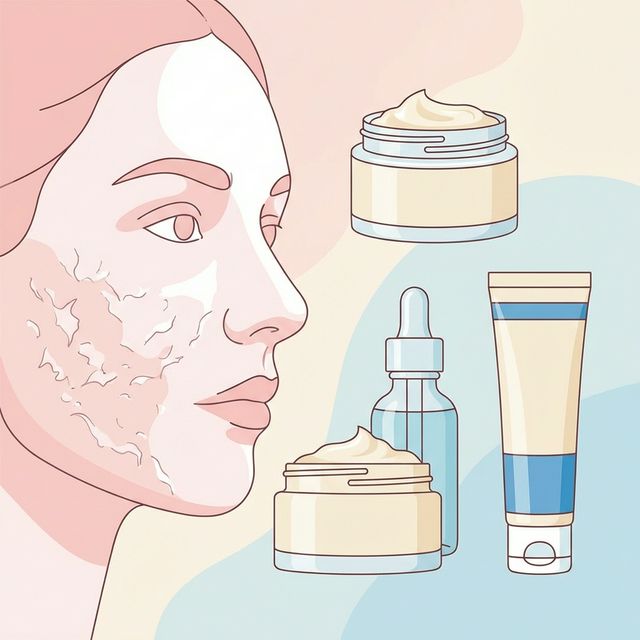
Flaking after starting a retinoid can be uncomfortable and make makeup difficult to apply. It does not tell you whether to keep using the product unchanged, change a dose or stop a prescribed treatment.
Peeling is not proof that the treatment is working. This guide helps you describe the symptoms, check your exact product and use basic care while getting the advice you need.
At a Glance
- Check the label: Cosmetic retinol and retinoid medicines have different instructions.
- Describe severity: Note pain, cracks, swelling, blisters and whether symptoms are worsening.
- Avoid removing flakes: Do not scrub, pick or add exfoliating products to sore skin.
- Review medicine changes: Follow reaction warnings and ask your prescriber about the next application.
- Skip the countdown: There is no universal peeling or recovery deadline, and no home test proves readiness to restart.
This is part of our complete Retinoids Guide.
A Self-Check That Does Not Diagnose
What does the peeling feel like?
- Is there dryness without discomfort, or also itching, burning or pain?
- Does washing, moisturizer or touching the area hurt?
- Are cracks, bleeding or raw areas present?
- Is the reaction interfering with sleep, work or daily care?
What changed before it started?
- A new product, formulation or strength.
- A change in amount, frequency or application area.
- Another medicine, exfoliant, cleanser, procedure or shaving product.
- Sunburn, colder weather or other environmental changes.
What is happening now?
Record whether symptoms are improving, unchanged or worsening. Note swelling, blisters or a spreading rash. A clinician may need to examine the skin; a checklist or photo cannot diagnose the cause.
Contact your clinician promptly for severe, painful, persistent or worsening symptoms. Follow medicine warnings rather than waiting for a set number of weeks. Breathing difficulty or sudden swelling of the mouth, lips or throat requires emergency help.
Why Peeling May Occur
Retinoid medicines can cause dryness, irritation and peeling. The effect varies with the product, how it is used and the person. Other skincare and underlying conditions can contribute, so timing alone does not prove that the retinoid is the only cause.
A fixed cell-turnover countdown cannot predict how much you should peel or when it must stop. Visible shedding is not a treatment target, and an absence of peeling does not mean that a medicine has failed.
Factors to review
| Factor | Question for the review |
|---|---|
| Product | What is the exact ingredient, strength and formulation? |
| Use | Does actual amount, area and frequency match the instructions? |
| Other products | Are optional exfoliants, scrubs or additional retinoids being used? |
| Skin history | Is there eczema, allergy, sunburn or another relevant condition? |
| Environment | Have weather, washing habits or exposure changed? |
Retinol, adapalene and tretinoin percentages do not form a single strength scale. Do not choose a replacement from a ranking of which product should peel less.
What to Do Next
If an optional cosmetic is causing irritation
Stop the optional cosmetic and avoid adding new actives to compensate. Seek advice if symptoms persist, worsen or concern you. A soothing label or familiar ingredient does not guarantee that a substitute will be comfortable.
If you use a retinoid medicine
Read its reaction instructions and contact your prescriber or pharmacist about the next step. The cited US tretinoin cream label tells patients with severe or persistent irritation to discontinue use and consult their physician. The cited US adapalene gel label says to stop and ask a doctor for severe irritation, including before restarting.
These are examples of product-specific warnings. They do not create one dosing rule for every retinoid. Do not invent an alternate-night schedule, wash the medicine off early, change its strength or resume it solely because the flakes look smaller.
If skin is painful, cracked, swollen or blistered
Arrange prompt medical advice and follow the product’s warnings. Do not put optional exfoliants on raw areas or try to remove the peeling skin. Severe or spreading reactions may need assessment sooner than a routine appointment.
See Retinoid Irritation & Barrier Repair for a symptom and treatment-review checklist.
Basic Care While You Seek Advice
Cleanse without friction
Use a gentle method that removes sunscreen and makeup without scrubbing. Hot water, repeated washing and rubbing with a towel may add discomfort. You do not need to strip away flakes to prepare the skin for moisturizer.
Choose a comfortable moisturizer
Use a formula you tolerate, following any instructions about layering it with medicine. More serum, oil or ointment is not automatically better. Ask before applying a heavy covering layer over a medicine.
A moisturizer that stings is information to report. It does not prove barrier damage, and a moisturizer that feels comfortable does not prove that the next medicine application is safe.
Keep sun protection practical
Use shade, protective clothing and a suitable broad-spectrum SPF 30 or higher sunscreen. Follow any extra sun precautions on your medicine. If the sunscreen causes a reaction, seek advice about an alternative formula; mineral filters are not automatically comfortable for everyone.
A Product Review Checklist
Use these questions instead of a self-directed dose adjustment:
- Frequency: What does my actual product say, and have I followed the prescribed plan?
- Layering: Where should moisturizer fit for this formulation?
- Amount and area: Am I treating only the areas directed, using the amount instructed?
- Product choice: Does this formulation still fit the treatment goal, given the reaction?
- Other exposures: Could another product, procedure or environmental change be relevant?
- Follow-up: What symptoms require earlier contact, and how will we assess the next step?
Record the answers rather than changing several things at once. Do not leave a worsening reaction unassessed while testing a new schedule.
A Routine Framework to Discuss
Evening
| Step | Purpose | Notes |
|---|---|---|
| Gentle cleanse | Remove sunscreen and makeup | Avoid rubbing off flakes. |
| Medicine, only as instructed | Follow the treatment plan | Use its specific amount, area, timing and dry-skin directions. |
| Comfortable moisturizer | Support dry skin | Confirm its position relative to the medicine. |
| Optional extras | Only if useful and tolerated | Do not add them simply to fill a routine. |
Morning
| Step | Purpose | Notes |
|---|---|---|
| Gentle cleansing as needed | Remove residue or sweat | Use a method that does not add discomfort. |
| Moisturizer as needed | Keep skin comfortable | A separate hydrating serum is optional. |
| Sun protection | Reduce UV exposure | Sunscreen as directed, shade and protective clothing. |
| Other prescribed care | Follow its instructions | Ask about combining treatments. |
This framework does not set medicine frequency or authorize a restart. Bring it to the clinician or pharmacist who can adapt it to your actual products.
Common Mistakes
Scrubbing or picking flakes
Trying to make skin look smooth immediately can add irritation. Cleanse gently and avoid pulling loose skin. Do not use an exfoliating mask as an exception for peeling skin.
Adding more products for every symptom
A new serum for tightness, an oil for flakes and a peel for texture can make the routine harder to evaluate. Give optional products a clear purpose and stop one that causes a reaction.
Treating peeling as a dose guide
The size of a flake cannot tell you a safe medicine amount or frequency. Likewise, a comfortable day does not authorize a higher strength. Use the treatment plan and ask for a review when needed.
Starting and stopping without a plan
If you have had to stop because of a reaction, ask how to proceed. Do not compensate with extra applications or improvise a restart schedule. Bring a record of actual use to the discussion.
Waiting for a promised adjustment period
Persistent symptoms deserve review, and severe or worsening symptoms need earlier attention. You do not need to reach a particular week before asking for help.
FAQ
How long does retinoid peeling last?
It varies by product, person and cause. Some product labels describe early irritation, but that is not a deadline for enduring symptoms. Ask about persistent peeling and seek advice sooner for pain, worsening symptoms or a concerning rash.
Is peeling a sign the retinoid is working?
Peeling is not proof of effectiveness and is not required to show benefit. Discuss the intended treatment outcome with your prescriber rather than using visible shedding as the measure.
Can I wear makeup over peeling skin?
If makeup is comfortable, use products you tolerate and remove them gently. Do not rub off flakes to create a smooth base. Avoid applying products to raw or painful areas, and stop an optional cosmetic that stings. More primer or setting spray is not necessarily helpful.
Should I exfoliate the flakes off?
Do not add scrubs or exfoliating products to irritated, peeling skin. They do not establish that the underlying problem has resolved. Ask about ongoing texture concerns after the reaction has been assessed.
Could peeling return after a treatment change?
A change can alter tolerability, but a reaction is not inevitable or something to plan to endure. Ask what to watch for and what to do before changing a medicine’s strength or formulation.
Can I apply the retinoid if my skin is already peeling?
A general guide cannot decide your next dose from peeling alone. Follow the exact product’s reaction instructions and contact your prescriber. An optional cosmetic that irritates should be stopped; prescribed medicine needs its own plan.
Keep Notes for the Next Review
Get the app to organize routine notes and record visible changes. It cannot diagnose irritation, determine whether skin has adapted or choose a medicine schedule.
What to Read Next
- Retinoids Guide — product-specific questions
- Retinoid Irritation & Barrier Repair — symptoms and when to seek advice
- Retinol Buffering (Sandwich Method) — moisturizer layering questions
- Retinoid Purging vs Breakout — describing new breakouts
- Skin scan — the limits of photo-based guidance
Sources
- DailyMed: US tretinoin cream label
- DailyMed: US EFFACLAR adapalene gel label
- MedlinePlus: Topical tretinoin side effects and precautions
- AAD: Moisturizer alongside acne treatment
- AAD: Dry skin care and when to seek advice
- NHS: Emergency symptoms of anaphylaxis
General education, not a diagnosis or individual treatment plan. Product instructions and advice from your treating clinician take priority.